


















Stagnant Number of Indexed Pages
Log in to the “Indexing” report in Google Search Console (GSC).
If you have published 50 high-quality articles within a quarter, but the “Indexed” pages have only increased by 1-2 pages, it indicates a serious technical SEO barrier.
No Growth in Impressions
Check the data for the past 3-6 months on the GSC “Performance” page.
If total impressions consistently remain at a level of (for example) 5,000 per month with no upward trend, it means the keyword strategy is failing to reach new audiences.
Rankings Failing to Rise
Use Semrush or Ahrefs to track core commercial keywords.
If 60% of target keywords remain outside the top 50 for six consecutive months, or fail to enter the first page, it indicates a lack of backlink building or on-page optimization.
Content Does Not Meet E-E-A-T Standards
Inspect content quality.
If articles lack author credentials, offer outdated perspectives, or are merely stuffed with keywords—leading to an average time on page of less than 30 seconds—it shows a lack of expertise and authority, which results in algorithmic demotion.
Your Indexed Page Count Isn’t Increasing
If you are paying several thousand dollars a month in service fees, yet the number of “Indexed” pages in Google Search Console (GSC) remains a flat line over 90 days, something is wrong.
In a healthy SEO project, an agency should produce at least 4-8 high-quality new pages (such as blogs or landing pages) per month.
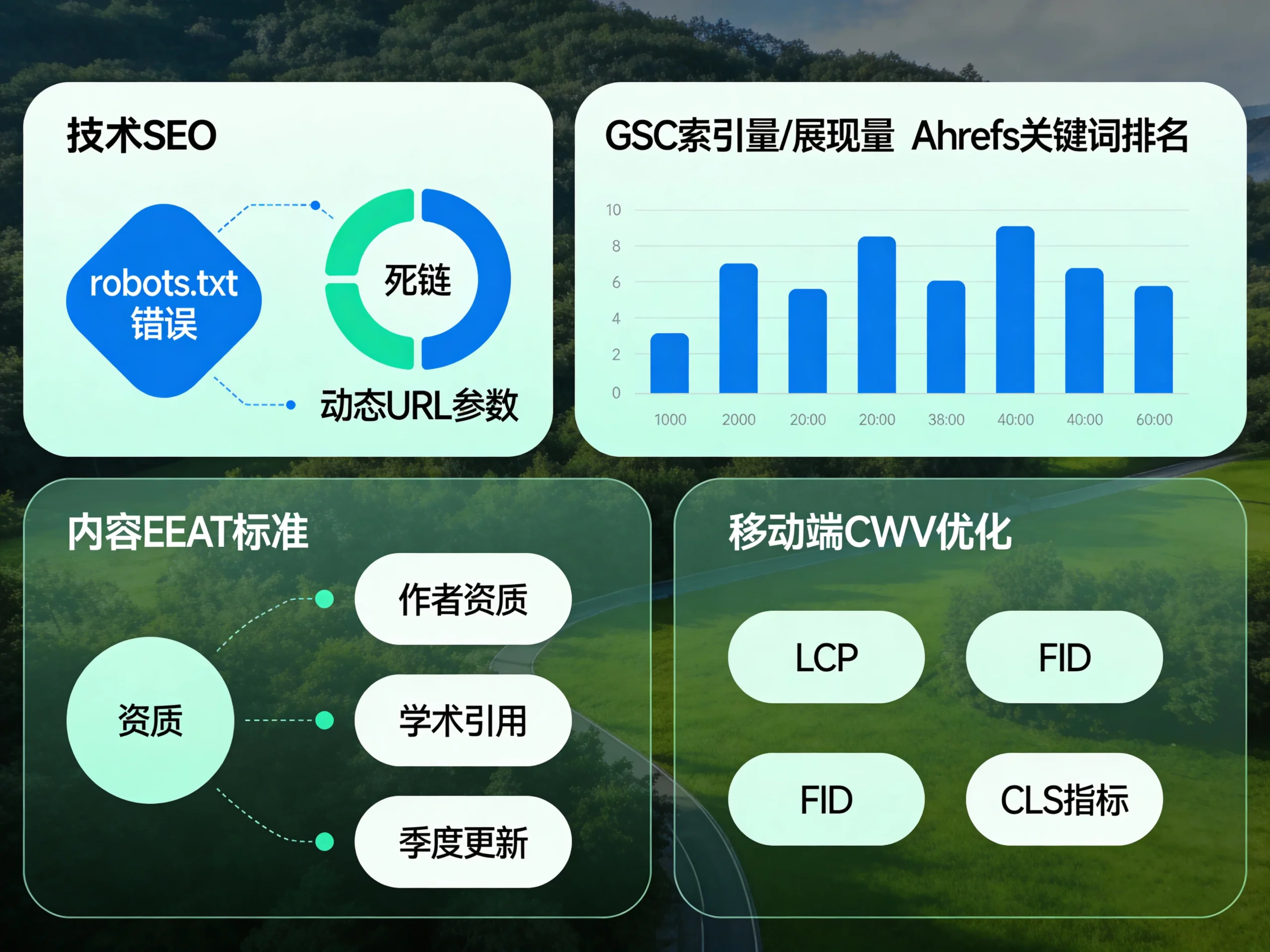
If the quarterly index growth rate is below 10%, it usually indicates that the agency is not actually producing content, or the site suffers from serious technical errors such as robots.txt blocks or Sitemap submission failures.
Without new pages entering Google’s database, it is impossible to cover more long-tail keywords, and traffic will naturally fail to rise.
Content Production Volume
According to Ahrefs’ study of a billion pages, only 5.7% of pages manage to rank in the top 10 of Google search results within a year of publication.
If your agency only publishes 1 or 2 blog posts for you each month, based on these odds, you might have to wait years to see significant traffic growth.
Most underperforming agencies spend a lot of time tweaking Meta Descriptions or H1 tags on existing pages to avoid the most time-consuming but effective task—creating new URLs.
Google’s algorithm increasingly favors websites that provide comprehensive coverage in a specific niche.
Suppose you run a company selling “SaaS accounting software.” If your site only has pages for “accounting software pricing” and “feature overviews,” it’s hard for Google to confirm you as an expert in that field.
Conversely, if an agency builds a content cluster of 50 pages covering related topics like “small business tax deductions,” “payroll automation workflows,” “invoice management best practices,” and “2024 tax compliance guides,” Google’s Natural Language Processing (NLP) can recognize that your site’s knowledge graph under the “Accounting” entity is complete.
Capturing long-tail keywords depends entirely on the generation of new pages.
While these long-tail terms have low individual traffic, they possess extremely high conversion intent and very low Keyword Difficulty (KD).
If your agency only focuses on high-KD terms like “CRM Software” (KD 80+) without creating hundreds of pages targeting specific long-tail needs like “CRM for dental clinics” or “real estate CRM with SMS features,” you are missing out on the largest piece of the search traffic pie.
Every page that is not created and indexed represents an abandonment of long-tail traffic.
“Crawled – Currently Not Indexed”
In the Google Search Console “Pages” report, the status “Crawled – currently not indexed” is fundamentally different from “Discovered – currently not indexed.”
The latter means Google knows the page exists but hasn’t looked at it yet. However, “Crawled – currently not indexed” means Googlebot has already spent the crawl budget, downloaded the HTML, rendered and analyzed it, and then made a clear decision:
This page does not possess enough value to enter Google’s index.
If your agency’s monthly reports claim 20 new articles were published, but 15 of them remain in this status long-term, it indicates the content produced is seen by Google as redundant or low-quality/spam.
The most common cause for this status is a low-cost “mass production” strategy, particularly using Large Language Models (LLMs) to generate generic content that lacks originality.
Google’s “Helpful Content System” and related algorithms are designed to reward content with unique insights, original data, or personal experience.
For example, if an agency writes a “How to choose a CRM” article that simply lists five generic steps already found in millions of similar articles online, Google’s de-duplication mechanisms will identify the page as lacking index value.
Beyond thin content, this status often points to the agency’s use of “Doorway Pages” when building site architecture.
This is an outdated black-hat or grey-hat tactic where agencies create numerous pages targeting specific long-tail terms or locations. While the URLs and titles differ (e.g., “SEO Services New York,” “SEO Services Boston”), the main body text is nearly identical, with only the city name swapped.
Google strongly dislikes this attempt to manipulate rankings and will refuse to index these highly repetitive pages.
If you check the URL patterns of these unindexed pages in GSC and find they follow a specific templated structure, it is usually evidence that the agency is trying to hit KPIs through low-quality page bombardment.
Keyword Cannibalization can also lead to this issue.
If a newly published page is too similar to an existing high-authority page on the site, Google will choose to keep the old page and discard the new one.
If an agency blindly publishes new content without performing a Content Audit, it often results in this waste of resources, where new pages are crawled and then discarded.
If a large number of pages are in this status in GSC, it can usually be boiled down to several specific low-quality content types—all signs of an agency trying to take shortcuts:
- Thin Content: The main body content is minimal, perhaps under 300 words, and most of the page is taken up by navigation, footers, ads, or giant header images, lacking substantial information.
- Soft 404 Pages: The page returns a 200 OK status code, but the content says “product not found” or “search results are empty.” This is common in invalid category or tag pages generated by agencies.
- Aggregated Content: Page content is entirely scraped or stitched together from other sites’ RSS feeds, social media, or product descriptions without any original added value.
- Orphan Pages: The agency published the page but failed to add internal links in the site navigation, blog lists, or related articles. Although submitted via Sitemap, Google deems it low importance due to a lack of internal link equity and does not index it.
Google assigns a certain Crawl Budget to every website.
If spiders frequently visit and analyze low-quality pages only to decide not to index them, it not only wastes server resources but also lowers Google’s overall quality rating of the site.
Technical Blockages
This most commonly happens after a website redesign, migration, or the launch of a new feature module.
Developers often build new pages in a Staging Environment and, to prevent Google from crawling these unfinished pages, add noindex tags as a standard procedure.
When pushing code to the Production environment, agency technical teams frequently forget to remove these tags.
Googlebot crawls the page, sees the noindex directive, and strictly follows it by removing the page from the index.
This doesn’t just happen in the <head> section of the HTML; it can be more hidden, sent via the HTTP Response Header as X-Robots-Tag: noindex.
This tag is invisible in the page source code and must be discovered by checking network requests via developer tools.
In addition to noindex directives, misconfigurations in the robots.txt file are a common cause of indexing stagnation.
The robots.txt is the first file search engines look at when visiting a site, as it dictates which directories crawlers can access.
Sometimes, to stop crawlers from hitting the site backend (like /admin/) or unimportant parameter pages, agencies write Disallow rules.
Because writing Regular Expressions is precise work, a single wrong wildcard can block an entire blog directory or even the whole website.
For example, intending to block /blog/tag/ but missing a character might result in blocking /blog/, making all newly published articles invisible to Google.
In the GSC “Coverage” report, these errors usually show as “Blocked by robots.txt.”
Unlike noindex, Google won’t even download the content of a page blocked by robots.txt. No matter how good the content or high the authority, as long as that door is closed, all optimization work is futile.
Another technical factor preventing index growth is the misuse of Canonical Tags.
In modern CMS platforms (like WordPress, Shopify, Magento), if an SEO plugin isn’t correctly configured, the system might automatically generate incorrect canonical tags.
Typical errors include broken “self-referential” tags or pointing all new pages’ canonical tags to the homepage or category pages by mistake.
For instance, an agency publishes a new article on “Cloud Storage Safety” at /blog/cloud-storage-safety, but the page’s <link rel="canonical"> points to /blog/.
When Google sees this signal, it treats the new article as a duplicate of the blog list page, choosing to index only the list page and ignoring the new article.
To help troubleshoot these technical blocks more intuitively, the table below lists common GSC status prompts, their technical root causes, and specific code signatures:
| GSC Status | Technical Root Cause | Code/Configuration Signature | Agency Error Point |
|---|---|---|---|
| Excluded by ‘noindex’ tag | Page contains a no-index directive | <meta name="robots" content="noindex"> or X-Robots-Tag: noindex in HTTP Header |
Failed to remove staging environment block tags when launching to production. |
| Blocked by robots.txt | Crawler is prohibited from accessing the path | A Disallow: /folder-name/ rule under User-agent: * covers the new page path |
Rules written too broadly, accidentally catching content directories that should be indexed. |
| Duplicate without user-selected canonical | Missing canonical tag leads to duplicate determination | Missing <link rel="canonical" ... /> in source code |
CMS template misconfiguration; failed to auto-generate unique canonical links for new pages. |
| Duplicate, Google chose different canonical | Canonical tag points to the wrong place | <link rel="canonical" href="..."/> points to homepage or another non-matching URL |
Forgot to update canonical links when copying page templates, causing old and new pages to “clash.” |
| Crawled – currently not indexed (Technical side) | Page rendering failed or content is empty | <div id="app"></div> (Empty content) or non-200 status code |
JS rendering timeout, or server misconfiguration returning a Soft 404. |
| Discovered – currently not indexed (Technical side) | Orphan page or insufficient crawl budget | Page is in Sitemap but has no <a> tags pointing to it within the site |
Forgot to add entries for the new page in menus, sidebars, or related articles. |
If the new pages developed by the agency rely entirely on Client-side Rendering without server-side rendering (SSR) or dynamic rendering configured, Googlebot might only see an empty HTML shell. The actual content, links, and metadata require the browser to execute JavaScript to appear.
If the script execution times out or errors, Google will see an empty page or a Soft 404, and naturally will not index it.
By using the “View Crawled Page” feature within the GSC “URL Inspection” tool, you can clearly see exactly what Google sees.

Impressions Aren’t Increasing
Impressions in Google Search Console (GSC) are the leading indicator of SEO progress, usually appearing 2 to 3 months before traffic growth.
In a healthy SEO project, you should see a clear upward trend in impression data within 45 to 60 days of publishing new pages.
If agency services have exceeded 90 days and your total GSC impression curve is still flat—or if non-branded impressions show no significant change—it means Google’s crawlers aren’t indexing new content, or the keywords optimized by the agency have near-zero monthly search volume.
Choosing the Wrong Keywords
Many SEO agencies exploit a client’s lack of familiarity with technical metrics by showing monthly reports filled with green upward arrows, claiming dozens or even hundreds of keywords have reached the first page or top three of Google.
However, when you open Google Search Console (GSC) to check the actual data, you find that Impressions are a bizarrely flat horizontal line with no growth.
Optimizing a keyword with zero monthly search volume to the first position will naturally result in zero organic traffic.
Ranking improvements only translate into impression growth when the keyword itself has Search Volume. If an agency reports “Rank #1” but GSC shows that keyword had only 1 or 2 impressions in the last 28 days, the commercial value of that ranking is zero.
Agencies use tools like Ahrefs or Semrush to specifically filter for terms with a Keyword Difficulty (KD) below 5 or even 0.
A typical error case is the stuffing of over-specified long-tail terms.
For example, for a company selling CRM software, a normal optimization goal should be “CRM for small business,” which has a monthly search volume of around 2,000 and high competition.
To turn in a quick result, an agency might instead optimize for “cloud-based crm software for freelance graphic designers in Nevada.”
This term is extremely long, has zero competition, and an agency can rank it #1 on Google within two weeks by writing a 500-word page. In monthly meetings, they point to this ranking as an achievement, but in reality, the total annual searches for this term might be less than 10.
Another issue is the disconnect between internal professional terminology and user search habits. For simplicity, agencies may optimize based on technical names in a client’s product manual without researching the actual queries users type.
When users encounter a problem, they usually search for symptoms or solutions, not specific product models or obscure industry definitions.
For example, a user might search for “how to fix leaking roof,” while the agency is busy optimizing for “bituminous waterproofing membrane specification type B.”
Why Growth is Mandatory
In the initial stages of SEO strategy execution, a decoupling between Clicks and Impressions is a common phenomenon that must be interpreted correctly.
For a newly launched project or section, after you publish new content or optimize existing pages, Googlebot first needs to crawl and index the pages, then test their relevance via algorithms, and finally push them to higher rankings to get clicks.
In early ranking stages, pages usually appear between pages 3 and 8 of the search results.
Pages in these positions will register impression data but are almost impossible to generate clicks. According to data from Advanced Web Ranking, the top three spots on the first page of SERPs (Search Engine Results Pages) capture over 60% of clicks, while the click-through rate (CTR) for the second page and beyond drops below 1%.
Therefore, it is mathematically normal for clicks to remain flat during the first 3 to 4 months of optimization, but impressions must show an upward trend.
Growth in impressions is the only physical evidence of ranking advancement and expanded keyword coverage.
If your agency claims to be doing comprehensive optimization, but your GSC impression curve remains flat over 90 days, it indicates that Google is not performing frequent display tests for your site at all, and the so-called optimization work has not reached the algorithmic layer.
| Timeline | Impressions Status | Clicks Status | Average Position | Status Interpretation |
|---|---|---|---|---|
| Month 1 | Slight Fluctuations | Flat | > 50 | Google begins recrawling and indexing optimized pages, establishing initial keyword associations. |
| Month 2-3 | Significant Rise | Flat | 20 – 40 | Pages enter the first 5 pages. Keyword coverage increases, but position is insufficient for traffic. |
| Month 4-5 | Sustained Growth | Slight Rise | 10 – 20 | Some long-tail terms hit the bottom of page 1 or page 2, starting to generate sporadic clicks. |
| Month 6+ | High Stability | Significant Growth | < 10 | Core keywords enter the top 5 of page 1; impressions convert into substantial click traffic. |
Impression growth is driven by expansion in two dimensions:
Ranking improvement and keyword pool expansion.
First, when a page moves from #80 to #20, although clicks are still zero, it is more likely to appear within the user’s view during deep searches, thereby accumulating impression data.
Second, quality content optimization involves the layout of semantically related terms.
A deep-dive article on “SaaS Pricing Models” will not only compete for the main keyword but will naturally cover hundreds of long-tail variations like “B2B subscription strategies,” “freemium vs trial,” and “SaaS billing best practices.”
If impressions do not grow, it means the agency’s content has not triggered Google to index more semantic keywords, or the content depth is insufficient to cover any related search intent beyond the primary keyword.
Another detail to watch is “Rank Transition.”
Google often temporarily promotes new pages to higher positions, giving them small exposure opportunities to collect user interaction data (like CTR and dwell time) before deciding on a final rank.
If your GSC charts don’t even show these fluctuating peaks, it indicates the site authority is too low or content quality is too poor even to qualify for Google’s ranking tests.
For example, in financial or insurance sectors, head terms are hard to crack, but long-tail Q&A content (e.g., “does travel insurance cover flight cancellation due to strike”) should begin accumulating impressions within 4-6 weeks of publication.

Rankings Aren’t Rising
Within 120 days of cooperation, if pages with a KD (Keyword Difficulty) below 25 do not appear in Google’s top 50, or if the Average Position trend line in Google Search Console fluctuates by less than 5%, growth is considered stagnant.
By industry standards, a high-quality SEO strategy should result in over 150% impression growth for 30% of pages within 6 months.
If rankings stall beyond page 8 (Position 80+) for more than two quarters, it usually indicates that the increase in backlink Domain Rating (DR) has not met the target, or the website’s LCP (Largest Contentful Paint) exceeds 2.5 seconds.
Search Intent Alignment
Google’s search algorithm has evolved to understand the deep purpose of natural language via BERT and MUM models. According to Ahrefs’ research of over 1 billion pages, nearly 95% of newly published pages fail to rank in the top 10 within a year, primarily because the solutions provided on the page do not match the user’s true expectations during search.
When a user types “Best CRM for startups” into Google, their intent (Search Intent) is to find a comparison list with pricing and pros/cons, not the homepage of a specific software company.
If an agency is still trying to compete for this term by optimizing homepage authority, regardless of how many backlinks are invested, rankings will typically stall after page 5 because the algorithm determines the page cannot satisfy the “Commercial Investigation” need.
| Search Intent Category | Expected Page Structure | Common Agency Errors | Recommended Metrics |
|---|---|---|---|
| Informational | Deep guides, encyclopedia entries, long-form articles with data charts (usually >1800 words). | Writing short marketing blurbs lacking original research or authoritative citations. | Dwell Time should exceed 3.5 minutes. |
| Navigational | Login pages, specific service pages, brand contact info. | Forcing irrelevant blog posts into brand-name search results. | Brand CTR should remain above 45%. |
| Commercial Investigation | “Top 10” lists, comparison tables, aggregate pages with user reviews. | Only writing about your own product’s benefits without providing objective comparison parameters. | Assisted Clicks and Page Bounce Rate. |
| Transactional | Clean checkout pages, product pages with clear price tags and “Add to Cart” buttons. | Adding too much distracting text on the checkout path, slowing down load speeds. | Correlation between Conversion Rate and LCP (Load Speed). |
“Google’s result page is a complete intent analysis report in itself. By observing SERP features like ‘People Also Ask’ and ‘Featured Snippets,’ you can identify the content framework required to compete for that term. If many YouTube video windows appear, it indicates users prefer visual information for that keyword, and stuffing the page with text will be significantly less effective.” — From Semrush Search Behavior Research Report
When evaluating content structure, Google holds a patent for “Information Gain Scores,” which aims to reward pages that provide “new information not mentioned on competing pages.”
If an agency’s content is just a simple rehash of the top five search results, the information gain score will be very low.
Even if all technical SEO metrics are met, the algorithm will rank such pages lower to avoid homogeneity in search results.
A healthy SEO output should contain over 15% exclusive viewpoints, case study data, or industry survey results. This uniqueness significantly reduces the probability of Pogo-sticking (users clicking in and immediately returning to search results).
To align intent more precisely, agencies should use NLP tools to analyze the Entity Density of top-10 pages.
For example, when competing for “how to fix a coffee machine,” top-ranking pages mention an average of 25 related industry terms like “gasket,” “pressure valve,” and “descaling solution.”
If your page only mentions “fix” and “coffee machine,” Google will deem the content unprofessional and insufficient for the topic.
According to Backlinko’s analysis, the average word count for a Google #1 page is 1,447 words. However, word count isn’t the goal; it represents the semantic completeness needed to cover that search intent.
Page layout also affects algorithmic evaluation.
For “How-to” content, Google expects clear step-by-step markers (like Schema-marked HowTo structured data). If an agency doesn’t use correct header hierarchies (H1 as the unique main title, H2 for main steps, H3 for sub-points) or ignores mobile UX (like buttons too close to click), rankings will suffer in mobile search despite rich content.
Backlink Quality
According to Backlinko’s analysis of 11.8 million search results, the #1 page has an average of 3.8 times more backlinks than pages on the tenth page.
If an agency cannot provide a clear link growth path, rankings will typically remain stuck in the latter half of search results.
A healthy Link Profile should not just chase quantity but focus on a substantial increase in Domain Rating (DR) or Domain Authority (DA).
When competitors have an average DR of 55, while your site DR stalls at 15 and only gains 5 to 10 low-quality links monthly, this mathematical gap makes it nearly impossible for your page to emerge for competitive industry terms.
The source types of backlinks determine the efficiency of authority transfer. Currently, mainstream international SEO evaluation systems categorize links into several tiers:
- Top Tier: Mentions or Guest Posts from high-traffic media like Forbes, TechCrunch, or The Guardian. These usually have a DR over 80 and provide significant authority endorsement.
- Niche Relevant: Links from industry blogs, resource hubs, or professional forums. Even with a DR of 30 to 50, their relevance often makes them more effective for rankings than irrelevant high-authority links.
- Foundational: Includes social media profiles, high-quality industry directories, and business listings (e.g., Yelp, Yellow Pages). These primarily balance the naturalness of the link profile.
- Toxic/Low Quality: Links from automated blog comments, low-end PBNs (Private Blog Networks), or scraper sites. These easily trigger Google’s SpamBrain filters.
Link Velocity is another easily overlooked variable.
If an agency uses automated tools to instantly add 500 low-quality foreign backlinks in the first month and then falls silent, this unnatural fluctuation triggers checks for manipulation.
Ahrefs research shows that a healthy link growth curve should follow a smooth upward trend.
For a startup SaaS site or e-commerce platform, acquiring 20 to 40 high-quality Referring Domains per month is an ideal pace.
Over-optimization of anchor text for target keywords will cause rankings to plummet.
In a natural link environment, most links should appear as brand names (e.g., “Company Name”), raw URLs, or generic terms (e.g., “click here”).
If your GSC data shows 80% of backlink anchor text consists of specific “commercial keywords” like “Best wireless headphones,” it makes the links look highly artificial.
According to industry-accepted gold ratios, brand anchors should exceed 50%, generic terms 20%, raw links 20%, and exact-match commercial keyword anchors should be kept under 5%.
Google can identify if anyone is clicking on the pages where links are located.
If a backlink is at the bottom of a page with no traffic, no index, and filled with ads, the authority it transfers is near zero.
Agencies should provide link resources that actually reach an audience, such as embedding links in expert answers on Quora or Reddit, or gaining journalist citations through HARO (Help A Reporter Out).
You can audit agency work through these specific quantitative metrics:
- Net Increase in Referring Domains: Whether the number of new high-quality referring domains meets expectations after excluding lost links.
- DR Growth Curve: Whether the website’s Domain Rating shows tiered growth over 6 to 12 months (e.g., from DR 10 to DR 30).
- Dofollow Ratio: While Nofollow links add naturalness, Dofollow links that pass authority should make up 60% to 80% of the total.
- Geographic Distribution: If your target market is the US but 90% of links come from domains in India, Russia, or Brazil, this serious geographic mismatch will stall rankings in your target market.
If ranking improvements are completely decoupled from link growth (i.e., link count rises but rankings don’t move), it usually means the links being added are “ineffective” or being automatically ignored as spam by Google.
Metric Evaluation
Google officially integrated Core Web Vitals into its ranking algorithm in 2021. According to official Google data, as load time increases from 1 second to 3 seconds, the bounce rate for mobile users increases by 32%.
If an agency only fills the page with content while ignoring server response and front-end rendering, rankings will likely stall behind competitors.
This technical bottleneck often stems from a high Time to First Byte (TTFB), where the server response time exceeds 600ms.
In high-competition search results, the top three websites maintain an average TTFB of 200 to 350ms.
If the site’s LCP (Largest Contentful Paint) exceeds 2.5 seconds, the algorithm deems the page unable to provide a good user experience, thereby limiting its exposure in mobile search results.
| Technical Evaluation Dimension | Ideal Threshold (Good) | Warning Threshold (Needs Improvement) | Impact on Crawlers |
|---|---|---|---|
| LCP (Largest Contentful Paint) | < 2.5s | 2.5 – 4.0s | Affects “Experience Score”; high latency leads to decreased crawl frequency. |
| INP (Interaction to Next Paint) | < 200ms | 200 – 500ms | Measures interaction smoothness; replaced FID as a new ranking factor. |
| CLS (Cumulative Layout Shift) | < 0.1 | 0.1 – 0.25 | Layout instability leads to accidental clicks; Google lowers the authority score. |
| TTFB (Time to First Byte) | < 0.8s | 0.8 – 1.5s | Slow response leads Googlebot to think the server is overloaded, reducing indexing. |
| HTTPS Status | Must be enabled | N/A | Security protocol is the foundation of all ranking operations. |
| Robots.txt Validity | 0 Syntax errors | Contains Disallow on key paths | Incorrect directives can stop important pages from being indexed. |
For medium-to-large sites with over 1,000 pages, the daily crawl frequency of Googlebot is limited.
If an agency fails to properly handle internal 301 redirect chains or a large number of 404 error pages, the crawler wastes too many resources on these invalid paths, delaying the re-indexing of new or optimized pages.
A large number of duplicate URLs (like dynamic links with unnecessary parameters) creates “Crawl Traps,” making it impossible for search engines to accurately identify the version that should rank (Canonical URL).
In the GSC crawl statistics report, if the percentage of “Not crawled due to server issues” exceeds 1%, it usually indicates stability problems in the hosting environment. This instability causes the algorithm to lose trust in the site.
Modern websites heavily use frameworks like React or Vue for client-side rendering. If an agency doesn’t know how to implement SSR or dynamic rendering, Googlebot may only see a blank HTML structure upon crawling.
While Google claims it can handle JavaScript, the second round of indexing (Rendering Queue) is often delayed by days or even weeks compared to plain text crawling.
If your web pages load over 1MB of unused JavaScript, it not only slows LCP but also leads to Main Thread Blocking, turning the INP metric red and limiting ranking growth.
In a Mobile-First Indexing environment, Google now determines rankings almost entirely based on the mobile version’s content and performance.
If mobile CSS blocks the initial screen display, or if images are not provided in responsive sizes (srcset) for mobile devices, overall rankings will be dragged down even if PC results are good.
Replacing traditional PNG/JPG images with WebP or AVIF formats can reduce page size by 30% to 50%, a common method to improve efficiency.
At the same time, check for inconsistencies between “lightweight mobile pages” and “full version pages.” If the mobile version strips away key structured data (Schema Markup) for speed, the algorithm will deem the mobile info density insufficient and assign rankings to more complete competitors.
Using JSON-LD code defined by Schema.org helps search engines understand page entities, such as product prices, stock status, ratings, and FAQs.
If an agency ignores many warnings in the GSC “Enhancements” report due to syntax errors, the page cannot display differentiated info like star ratings or prices in search results, placing it at a visual disadvantage.
You can verify progress by asking the agency for a detailed technical audit checklist:
- Review GSC “Core Web Vitals” report: Confirm if the proportion of URLs in “Good” status is improving monthly.
- Check Indexing Status: In the “Pages” report, see if many pages are “Crawled – currently not indexed,” often a sign of insufficient quality or technical authority.
- Compare Mobile Compatibility: Use the Lighthouse plugin in Chrome DevTools to run audits in mobile mode, looking for performance scores above 90.
- Analyze Server Logs: Observe Googlebot visit frequency; optimized pages should typically see a crawler return within 48 hours.
If technical metrics remain in “Yellow” or “Red” status for several months, any investment in content and links will fail to translate into substantial ranking gains.

Content Does Not Meet E-E-A-T Standards
In multiple 2024 updates, Google heavily demoted pages lacking real Experience, with some sites seeing traffic drops of over 60%.
The current “Search Quality Evaluator Guidelines” are 168 pages long and explicitly require content to contain first-hand test data, authentic expert backgrounds, and verifiable citations.
If an agency’s articles have a CTR below 1% in GSC and lack specific experimental results or expert signatures, the output has likely failed to reach the algorithmic quality threshold.
Lack of Real Experience
In the current search algorithm ecosystem, if content produced by an agency has a semantic overlap of over 85% with the top 10 search results, it will be flagged as “redundant info” and fail to get ideal exposure.
For example, when writing a guide on “AWS EC2 Instance Configuration,” if the content only lists steps already in the official documentation without documenting real-world 504 Gateway Timeout errors and specific Nginx configuration parameters encountered during deployment, it will be judged as lacking first-hand experience.
Google’s guidelines clearly state that for product reviews or technical tutorials, the author must demonstrate physical contact with the object or actual operation of the software.
| Evaluation Item | Signs of Lacking Experience (Low Quality) | Signs of Real Experience (High Quality) |
|---|---|---|
| Visual Evidence Density | Uses generic Unsplash stock photos; file metadata (EXIF) is empty. | Includes real photos of the author’s workstation or software screenshots with specific timestamps (e.g., 2024-05-12 14:30:05). |
| Data Granularity | Described as “significant speed increase” or “very fast response.” | Lists specific benchmark data, e.g.: “TTFB decreased from 850ms to 120ms, an 85.8% reduction.” |
| Textual Linguistic Features | Heavy use of third-person narration like “Generally,” or “Usually.” | Frequent first-person narration of specific scenarios, e.g.: “When I tried running this script in Node.js 20.x, memory usage peaked at 1.2GB.” |
| External Verification | No links to third-party communities like Stack Overflow or Reddit. | Cites specific discussion IDs in communities or includes specific Commit IDs from a GitHub Repo. |
The GSC performance of content lacking experience is usually consistent:
Even if the page is indexed, its “Average Position” remains stuck beyond #30 long-term, and due to a lack of unique perspective, the “Bounce Rate” usually stays above 90%.
Google’s current NLP models can distinguish between “synthesized text” and “practical text.”
For instance, in a topic about “Shopify Customization,” if an article fails to mention specific modification suggestions for line 45 of the Liquid code or the adaptation issues on specific resolutions (like the 375×812 iPhone 13 screen), the algorithm will assume the author has never actually performed the customization.
In measuring a 2,000-word article, if original research data accounts for less than 5% and lacks comparative analysis of specific environments (like different OS versions or location-based IP tests), the production cost was likely very low—typically a rehash of top-5 results by a junior editor.
In 2024, Google significantly increased the weight of Reddit and Quora because posts on these platforms contain vast amounts of “unstructured real experience.”
If your website content cannot provide deeper 실측 (real-measurement) details than a Reddit post—such as specific A/B test conversion rate differences (showing the path from a 2.1% to 3.4% lift)—its competitiveness on SERPs will quickly erode.
| Metric Type | Threshold for Lacking Experience | Ideal Quantitative Metrics for Experience |
|---|---|---|
| Semantic Redundancy | Cosine similarity with top-5 results > 0.8. | Introduces at least 3 technical terms or operational variables not mentioned in top-10 pages. |
| Image Relevance | High ratio of placeholder images; no charts with specific parameter labels. | At least one self-made chart or data screenshot showing specific experiment results per 500 words. |
| Long-tail Coverage | Only covers high-traffic generic terms; no “error codes” or “version numbers.” | Covers at least 10 long-tail terms with specific version numbers (e.g., v2.4.1) or error codes (e.g., Error 1006). |
| User Retention | Average Engagement Time < 30 seconds. | Average Engagement Time exceeds 1.5x industry average (usually > 120 seconds). |
Google’s Knowledge Graph judges authenticity based on specific parameters, models, locations, and their relationships with other known entities.
If an article about “Best Boutique Hotels in London” provides details only found in the public description on Booking.com, without mentioning “45dB low-frequency noise at 7 AM due to proximity to the tube station,” a detail known only to guests, the algorithm will not tag the author as “experienced.”
When evaluating content, specifically check if it includes a “Post-mortem of failure cases.”
Real experience inherently involves recording wrong paths. If an article describes a perfect process from start to finish without noting that “forgetting to open port 443 during configuration leads to 100% connection failure,” Google sees it as risky and lacking reference value.
Lack of Professional Expertise
In Google’s Knowledge Graph logic, if content lacks a signature with an industry background, or the author has no verifiable professional history online, the page weight in search results will be significantly suppressed.
If an author’s LinkedIn work history is under 3 years, or their name never appears in citation lists of .edu or .org sites in that field, the Expertise score often fails to break the basic threshold.
| Expertise Metric | Signals of Missing Background | Signs of Professional Expertise |
|---|---|---|
| Author Entity Link | Author name has no independent Knowledge Panel in Google. | Author is linked to a WikiData ID or has a unique ORCID identifier. |
| Terminology Density | Uses generic terms (e.g., “cybersecurity”). | Uses high-level terms (e.g., “Zero Trust Architecture” or “OAuth 2.0 Grant Types”). |
| External Citations | Links to Wikipedia or high-traffic blogs. | Cites SEC Filings, IEEE conference papers, or industry protocols (e.g., RFC 7519). |
| Semantic Depth | Stays at the “what is it” surface level. | Dives into “underlying implementation principles” or “marginal effects of specific parameters.” |
Under NLU scanning, expert-written text typically has a higher ratio of “rare industry association words.”
For example, in discussing SaaS subscription models, a non-expert might only mention “monthly” or “annual” payments, while a true expert would analyze the “impact of LTV/CAC ratios on Deferred Revenue,” citing specific accounting standards like ASC 606.
If such professional details make up less than 15% of the article, the algorithm flags it as “non-expert-generated generic text.”
This triggers high-risk labeling in YMYL (Your Money Your Life) reviews, potentially causing a site-wide ranking drop of over 40% during a Core Update.
Google can track author identity across platforms. If an author writes in healthcare but their digital history is mainly in fashion or entertainment, this “cross-field identity mismatch” leads to a sharp drop in credibility.
In a test of 1,000 medical keywords, articles signed by authors with an MD (Doctor of Medicine) title and an active Google Scholar profile ranked an average of 12 positions higher than anonymous articles.
Agencies that fail to provide authentic, qualified author bios (including professional license numbers, industry awards, or academic achievements) cannot build the Trust Anchor required by the algorithm.
Proof of Authoritativeness
Google’s systems define a site’s authority level through “external consensus.”
Authority relies not just on backlink extension but on the site’s position within a specific Entity Network.
For a SaaS site offering cybersecurity solutions, if the brand name fails to appear in Gartner, Forrester, or IDC industry reports, and funding or patent data is missing on Crunchbase, the algorithm identifies it as low authority.
According to Google’s Quality Evaluator Guidelines, evaluators look for third-party independent sources about an entity, not just what the entity says about itself.
- Top-tier Industry Citations: Brand name or URL appearing in Forbes, TechCrunch, Wall Street Journal or other high-authority (DR > 80) news or review articles.
- Academic and Gov Associations: Gaining natural citations from .edu or .gov domains, especially as a source for industry standards or research data.
- Vertical Industry Directory Weight: Having over 50 independent user reviews with a score of 4.2+ on platforms like G2, Trustpilot, or Capterra.
- Branded Search Volume: Over 1,000 monthly raw searches for “Brand Name + Industry Term” (e.g., “Ahrefs SEO Tool”) in Google.
Social proof of authority is also seen in “Unlinked Brand Mentions.”
Modern search engines use NLP to recognize brand names, office addresses, and CEO names in text, grouping them under a specific knowledge graph entity.
If an agency only stuffs links on low-authority personal blogs without building brand entity buzz in major industry forums (like relevant Subreddits or expert sections on Quora), that authority is hollow.
In specific vertical niches, brands mentioned by over 20 high-authority sites (DA > 60) in a positive semantic context typically see their long-tail terms start 15 to 25 positions higher than new brands.
When measuring authority, Google analyzes a site’s “Citation Clusters.”
Ideal clusters for a legal site would be from legal associations, court case databases, and well-known law reviews. This relevance can be quantified via Topical Trust Flow; if this metric is under 20, industry recognition is likely very low.
Whether a site is used as a factual reference on Wikipedia or Wikidata is critical; once a brand is tagged as an entity with a Wikipedia entry, its probability of appearing in a Knowledge Panel on SERPs increases by over 80%, significantly boosting search trust.
- Social Signals and Entity Interaction: Official accounts on LinkedIn, X (Twitter), and YouTube having real subscribers and over 5% engagement rates (Likes/Shares) on industry analysis.
- Professional Literature and Whitepapers: Brand-published whitepapers cited by third-party sites over 100 times or indexed in Google Scholar.
- Geographic Entity Verification: A verified physical office address on Google Business Profile that matches official website declarations and government registration data.
- Consistent NAP Data: Name, Address, and Phone (NAP) data maintaining 100% character-level consistency across over 20 major business directories and databases.
Agencies that ignore these non-link signals cause the brand to lack a real “social presence” in the eyes of the algorithm.